 Carna
Speaking and writing practice: assign one, or write your own
Fifty ready scenarios, and a builder that drafts one from a sentence about your class. Practice is in beta.
Practice is the speaking and writing side of Carna: a student talks to a character in a situation, or writes, and hands it in. It is marked as practice, not as a test.
The section is in beta.
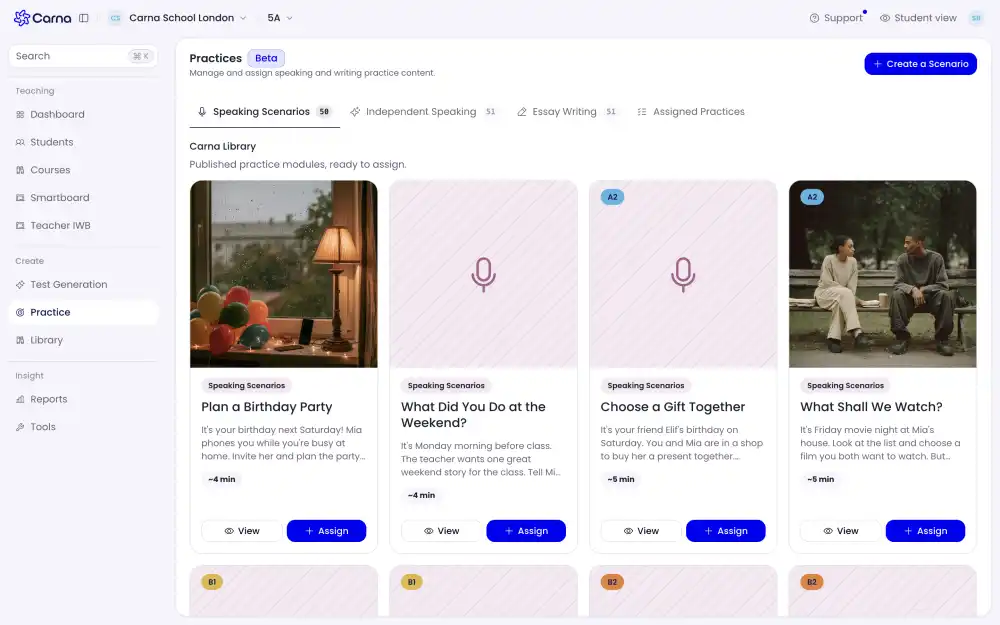
Three kinds #
- Speaking Scenarios — a conversation with a character, in a situation. The student has goals to reach inside the conversation.
- Independent Speaking — the student speaks alone, with no partner.
- Essay Writing — written, not spoken.
Two tabs hold them: Assigned Practices is what your class already has, and the Carna Library is the published catalogue — around fifty of each, ready to assign.
A card shows the level, the situation in plain words, and how long it takes — most are ~4 minutes. View opens it; Assign sends it to a class, the same way a module is assigned.
Writing your own #
Press Create a Scenario. You describe the situation and Carna drafts it; you shape it afterwards by chatting with it.
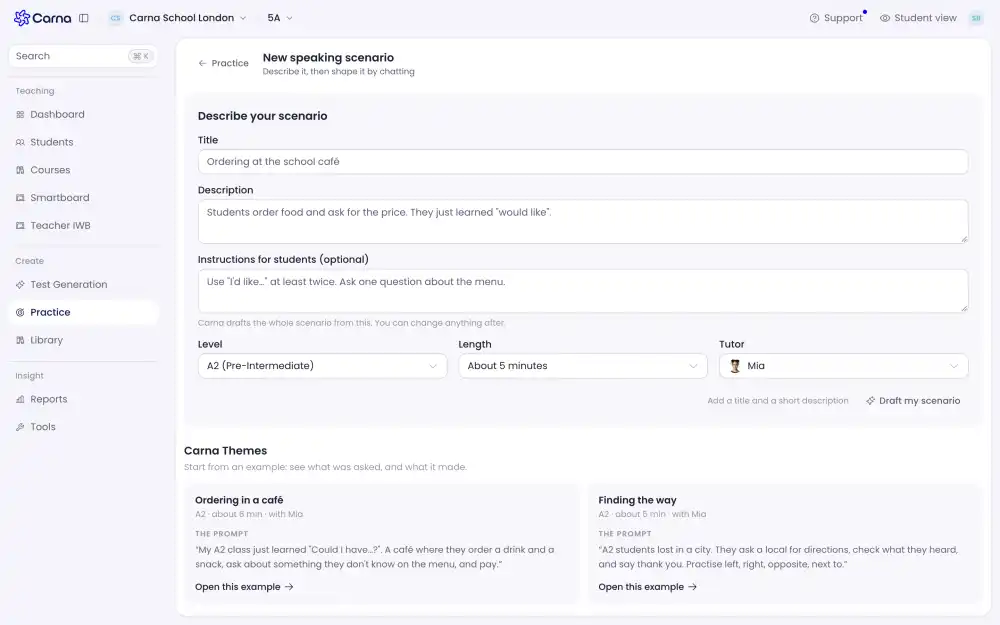
You give it:
- Title and description — the description is what Carna drafts from, so write it like you would explain the task to a colleague.
- Instructions for students — optional, and only shown to them.
- Level — A1 to C1.
- Length — about 3, 5, 8 or 10 minutes.
- Tutor — Mia or Hana. This is the character the student talks to.
Then Draft my scenario. The button stays off until there is a title and a short description.
What a good description looks like #
The Carna Themes section at the bottom is the useful part: each example shows the prompt that produced it, not just the result. Two real ones:
"My A2 class just learned Could I have…?. A café where they order a drink and a snack, ask about something they don't know on the menu, and pay."
"A2 students lost in a city. They ask a local for directions, check what they heard, and say thank you. Practise left, right, opposite, next to."
The pattern is the same in both: the language point first, then a situation that forces it, then the specific things the student must do. A description like "a conversation at a café" gives Carna nothing to aim at.
Open this example loads one so you can see what that prompt turned into before you write your own.
What your students see #
The scenario opens with a goals checklist — 0/6, grouped by stage — and goals that unlock as the conversation reaches them. They talk with tap or hold to talk, and they can end it whenever they like; the report covers what they did.
Their side is written up in Practices: speaking and writing.